

Starting your first quilt can feel like standing at the bottom of a mountain with no map. There are rulers, rotary cutters, seam allowances, and a hundred fabric choices staring back at you. The good news? You don’t need advanced piecing skills to make something beautiful. The right beginner quilt patterns can turn that overwhelm into genuine excitement, block by block.

Whether you’re sewing your very first stitch or you’ve made a few wonky pillow covers and want to graduate to a real quilt, this list is built around one idea: simplicity that still looks stunning. Below are ten easy quilt patterns that new quilters return to again and again, along with why each one works so well for someone just starting out.
Why Starting Simple Actually Makes You a Better Quilter
Before jumping into the list, it’s worth saying this clearly: choosing a simple pattern for your first project isn’t “cheating.” It’s strategy. When you pick a beginner-friendly quilt pattern, you get to practice the fundamentals — straight seams, pressing, squaring up blocks — without fighting curved piecing or tiny half-square triangles at the same time. Master the basics first, and the fancier patterns will come together far more smoothly later.
Many experienced quilters will tell you their favorite finished quilts weren’t the most complicated ones. They were the ones where the fabric choices sang and the piecing was clean. That’s entirely achievable on day one.
1. The Classic Rail Fence
The Rail Fence block is just strips of fabric sewn together and then rotated to create a woven, basket-like effect. There’s no matching of points, no set-in seams — just straight lines. It’s often the very first block new sewists are taught, and for good reason: it teaches accurate quarter-inch seams while producing a genuinely striking quilt top.
2. Simple Squares (Also Called a Postage Stamp Quilt)
Sometimes called the “I Spy” quilt when made with novelty prints for kids, this pattern is literally a grid of same-sized squares. It’s forgiving, endlessly customizable, and a fantastic way to use up a fat quarter bundle you’ve been hoarding. Because every seam is identical, your hands quickly build muscle memory.
3. Half-Square Triangles (HSTs) in a Simple Grid
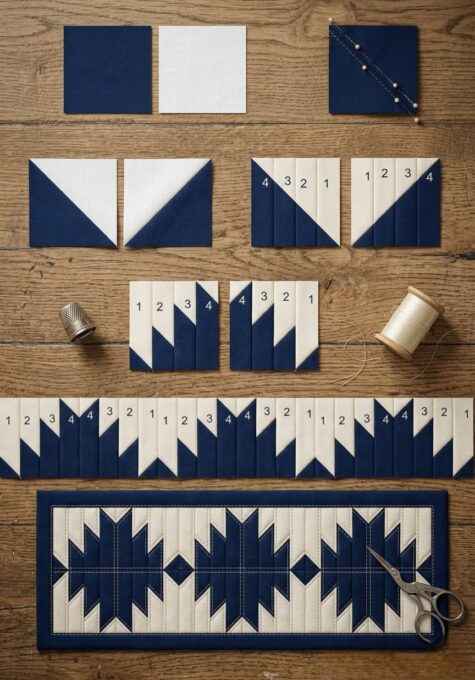
Half-square triangles look intimidating from a distance, but the “two squares, one line, sew, cut” method makes them approachable even for total beginners. Arranged in a simple grid, HSTs create secondary patterns — pinwheels, hourglasses, or diagonal stripes — that look far more advanced than the actual sewing involved.
4. Log Cabin
The Log Cabin block has been a quilting staple for over a century, and it remains one of the best patterns for new quilters. You build outward from a center square, adding strips (“logs”) one at a time. Every seam is straight, and the block naturally teaches consistent pressing technique. Change up your light and dark fabric placement, and you can create dramatically different overall quilt designs from the exact same block.
5. Disappearing Nine-Patch
A Nine-Patch block is nine squares sewn into a grid — about as basic as quilting gets. The “disappearing” version takes that finished block, cuts it into quarters, and reassembles the pieces to create a completely new, more complex-looking design. It’s a wonderful confidence booster because it shows beginners how a small trick can dramatically transform a simple block.
6. Charm Square Quilts
If you’ve ever bought a charm pack (a bundle of 5-inch precut squares) and wondered what to do with it, this is your answer. Charm square quilts skip the cutting step entirely, which removes one of the more error-prone parts of the process for newer sewists. All that’s left is arranging colors and stitching straight seams.
7. Strip Quilts (Jelly Roll Quilts)
Similar in spirit to charm squares, strip quilts use precut fabric strips (often called a “jelly roll”) sewn edge to edge. Many popular strip-quilt patterns can be finished in a single weekend, which makes them ideal for a beginner who wants to see a full quilt top come together quickly rather than working on a project for months.
8. Four-Patch Variations
The Four-Patch is even simpler than the Nine-Patch — just four squares joined together. Don’t let the simplicity fool you, though. Rotate colors, mix in a few half-square triangles, or alternate scale, and this humble block can anchor everything from a modern baby quilt to a scrappy lap quilt.
9. Big Block Quilts
Big block patterns use large pieces of fabric — sometimes a single fat quarter per block — to minimize the total number of seams in the quilt. Fewer seams mean fewer chances for things to go wrong, and the large-scale prints really get to shine. This is a favorite technique for quilters who want a finished project without weeks of piecing.
10. Simple Diagonal Set (On-Point Squares)
Turning plain squares on point (rotated 45 degrees) instantly makes a basic block look more dynamic, and the actual sewing is still just straight seams plus a few setting triangles. It’s a small design shift that makes a huge visual difference — proof that you don’t need complicated piecing to create something eye-catching.
Common Mistakes New Quilters Make (and How to Avoid Them)
Even with the simplest easy quilt patterns, a handful of small mistakes tend to trip up first-timers. Knowing about them ahead of time can save you hours of unpicking seams.
The most common one is an inconsistent seam allowance. Quilting almost universally relies on a scant quarter-inch seam, and even a millimeter of variation, repeated across dozens of blocks, can throw off your entire quilt top’s alignment. Investing in a quarter-inch presser foot early on solves this problem instantly.
Another frequent stumbling block is pressing instead of ironing. It sounds like a small distinction, but dragging a hot iron back and forth across freshly sewn seams can stretch and distort your fabric, especially on the bias. Pressing straight down, lifting, and moving to the next spot keeps your blocks square and your points sharp.
Finally, many beginners skip squaring up their blocks before joining them. Fabric shifts slightly during sewing, and a quick trim with a rotary cutter and ruler after each block ensures everything lines up when it’s time to assemble the quilt top. It’s a small extra step that makes the difference between a top that lies flat and one that puckers.
Tips for Choosing Your First Quilt Pattern
A few things to keep in mind as you pick your project:
- Start smaller than you think you need to. A baby quilt or lap quilt lets you finish — and finishing is what builds real confidence.
- Pick a pattern with repeated blocks. Repetition is how skills stick. By your fifth identical block, your seams will already look noticeably better than your first.
- Don’t chase trends over technique. A pattern might be beautiful on Pinterest, but if it uses curves or paper piecing you haven’t tried yet, save it for project number three or four.
- Pre-wash your fabric if you’re using cottons that might shrink or bleed, especially with darker colors next to whites.
If you’d like structured, video-guided instruction while you work through your first blocks, the beginner’s guide from National Quilters Circle is a solid resource for understanding essential tools and supplies before you even thread your machine.
Final Thoughts
The best beginner quilt patterns aren’t the ones that impress other quilters — they’re the ones that get finished, get used, and make you excited to start the next project. Pick one pattern from this list, gather a small stack of fabric you genuinely love, and give yourself permission to make an imperfect first quilt. Every quilter’s stash started exactly there.